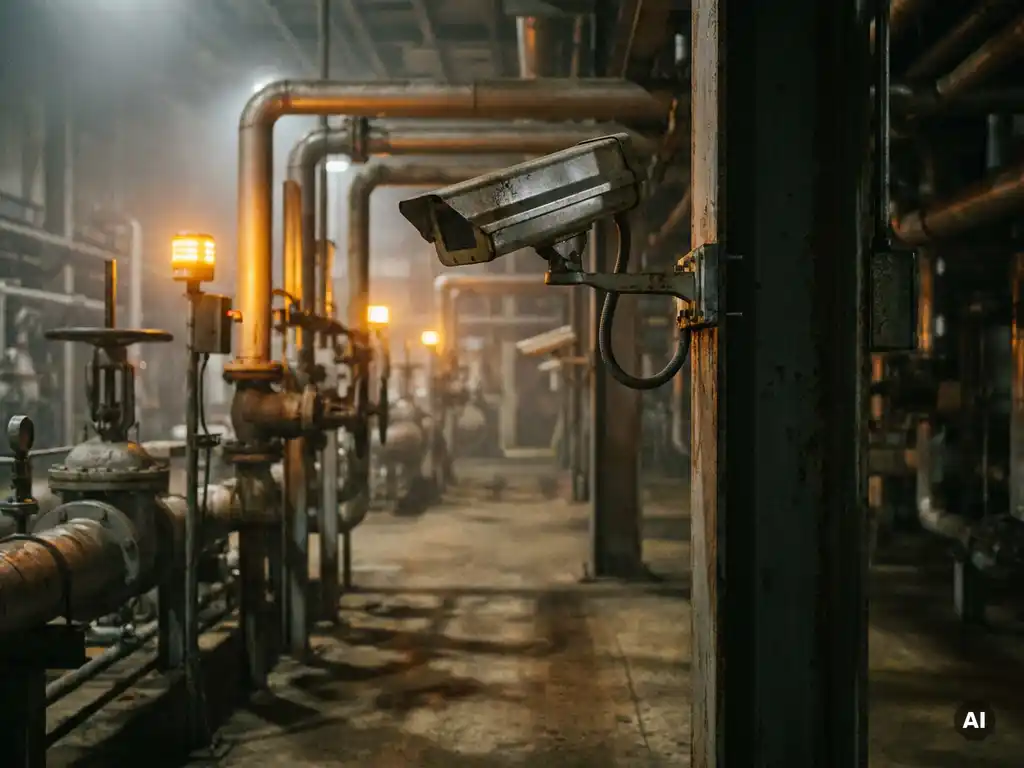
How do you secure a building in an explosion-hazardous environment?
You secure a building in an explosion-hazardous environment by using only certified, ATEX-compliant equipment and aligning the security solutions with the applicable zone classification. This applies to every system installed in or near the risk zone, from cameras to access control. Do you have questions about your specific situation? You can always contact with Sellox for tailored advice. In this article, we answer the most frequently asked questions about safety in explosive environments.
What risks does an explosive environment pose to security?
Explosive environments pose a particular risk to security systems because conventional equipment can generate sparks, heat, or electrical disturbances that can trigger an explosion. Standard security equipment is not only unsuitable in these environments but downright dangerous. The presence of flammable gases, vapors, mists, or dust particles makes any non-certified device a potential ignition source.
In concrete terms, this means that security professionals in sectors such as the petrochemical industry, the pharmaceutical industry, grain storage, or paint production deal with environments where any device producing heat or an electrical spark poses a direct danger. Even a small static discharge can be sufficient to ignite an explosive mixture in a Zone 0 or Zone 1 environment. This places fundamentally different demands on the selection and installation of security systems than in an office or retail environment.
What are ATEX zones and how do they determine the protection requirements?
ATEX zones are official classifications that indicate how frequently and for how long an explosive mixture is present in a specific area. The zone classification directly determines which equipment may be used and which safety standards apply. The higher the risk, the stricter the requirements for the equipment used.
The layout works as follows:
- Zone 0: An explosive gas mixture is present continuously or for long periods. Only Category 1G equipment is permitted.
- Zone 1: An explosive mixture may occasionally occur during normal use. Category 1G and 2G equipment is permitted.
- Zone 2: An explosive mixture is unlikely under normal use, but may occur incidentally. Category 1G, 2G, and 3G equipment is permitted.
- Zones 20, 21 and 22: Similar classification, but for dust explosions instead of gas or vapor.
The ATEX directives (EU Directive 2014/34/EU for equipment and 1999/92/EC for the workplace) specify which equipment may be deployed in which zone. Legally, a protection system that is not certified for the correct zone may not be installed, regardless of the functional performance of the system.
Which protection systems are permitted in ATEX zones?
In ATEX zones, only protection systems equipped with a valid ATEX certification corresponding to the zone classification of the location are permitted. This includes cameras, detectors, alarm systems, and communication equipment specifically designed not to constitute ignition sources.
Permitted and widely used systems include:
- ATEX-certified surveillance cameras: Explosion-proof enclosures that prevent sparks and excessive heat generation.
- Intrinsically safe detectors: Smoke detectors, gas detectors, and motion sensors that are designed to operate with minimal electrical energy, so that they cannot cause ignition.
- Explosion-proof alarm systems: Sirens and strobes with a certified housing that function safely even under extreme conditions.
- ATEX-compliant communication equipment: Two-way radios and intercom systems with the correct zone certification for use in high-risk areas.
Each device must bear the ATEX mark with the correct category designation. It is not permitted to adapt or modify standard protective equipment and subsequently use it in an ATEX zone, unless the modification itself is certified.
How is access control arranged in buildings with a risk of explosion?
Access control in buildings with a risk of explosion requires ATEX-certified readers, barriers, and electronic locks that are aligned with the zone classification of the relevant passages. The system must prevent unauthorized persons from entering the risk zone but must not itself constitute a source of ignition.
In practice, the following measures are often combined in buildings with a risk of explosion:
- Explosion-proof card reader systems or biometric terminals at access points to the risk zone.
- Lock or airlock systems where persons first pass through a safe zone before entering the ATEX zone, so that pressure changes and the introduction of ignition sources are limited.
- Registration of who enters and leaves the zone, which also provides insight into the presence of people during emergencies.
- Integration with the broader security system, so that in the event of an alarm, access is automatically blocked or released for evacuation.
A well-designed access control system not only contributes to employee safety but is also a legal requirement in environments subject to ATEX directives. The selection of the right equipment and the configuration of the system require specialized knowledge of both security and explosion safety.
What are the legal obligations regarding security in explosive atmospheres?
Employers and owners of buildings with an explosion hazard are legally required to draw up an explosion safety document, classify the environment into ATEX zones, and use only certified equipment. These obligations stem from the European ATEX Directive 1999/92/EC, which has been transposed into Dutch law by the Working Conditions Decree.
The most important legal obligations are:
- Risk assessment and zone classification: The employer must determine which areas are at risk of explosion and classify them into the appropriate zones.
- Explosion safety document: A written document describing the risks, measures, and responsibilities. This document must be kept up to date.
- Use of certified equipment: Only ATEX-certified equipment may be used in the classified zones.
- Employee training: Personnel working in or near ATEX zones must be demonstrably trained in the specific risks and safety measures.
- Periodic inspection: Safety systems and other installations in ATEX zones must be regularly inspected and maintained by authorized persons.
In the event of non-compliance, companies risk not only fines from the Dutch Labour Inspectorate but also liability in the event of any incidents. The legislation is deliberately strict because the consequences of an explosion in an industrial environment can be devastating.
Who is authorized to install security systems in an ATEX environment?
Protection systems in ATEX environments may only be installed by certified installers who possess demonstrable knowledge of both protection technology and explosion safety. A standard protection company without ATEX knowledge is not authorized to carry out installations in classified zones.
A qualified installer possesses knowledge of the ATEX directives, understands the zone classifications, and knows which equipment may be used in which situation. Additionally, the installer must be able to document the installation in a manner consistent with the client's explosion safety document. After installation, a formal handover and inspection are required, demonstrating that all components have been correctly installed and certified.
Engaging an unauthorized party is not only legally incorrect but can invalidate the equipment's ATEX certification and place liability on the client. Therefore, always choose a specialized partner with demonstrable experience in hazardous environments. Contact us with Sellox to discuss how we can secure your premises safely and in compliance with regulations.
Frequently Asked Questions
How do I know which ATEX zone my building or workspace falls into?
The zone classification is determined by a risk assessment that you, as an employer, are required to carry out, preferably together with a certified ATEX specialist. This involves examining the nature and quantity of flammable substances present, the ventilation of the space, and the likelihood of an explosive mixture forming. The result is recorded in the explosion safety document. Are you unsure about the correct classification? Then engage a specialized party, as an incorrect zone determination can have direct legal and safety consequences.
What are the most common mistakes when securing ATEX zones?
A common mistake is using standard security equipment that, while functionally sound, is not certified for the zone in question — this is both dangerous and legally prohibited. Additionally, zone classification is sometimes underestimated, resulting in the installation of equipment of a category that is too low. Another common error is outsourcing the installation to a security company without demonstrable ATEX knowledge, which can invalidate the equipment certification and place liability on the client.
How often must protection systems in an ATEX zone be inspected?
The law mandates that installations in ATEX zones be inspected periodically by a qualified person, but the exact frequency depends on the type of installation, the zone classification, and the environmental conditions. In practice, an annual inspection is recommended for most protection systems, supplemented by checks after every modification or incident. The results of each inspection must be documented and included in the explosion safety document to comply with legal requirements.
Can existing protective equipment be modified to meet ATEX requirements?
No, it is not permitted to modify standard protective equipment and subsequently deploy it in an ATEX zone, unless the modification itself is fully certified in accordance with the applicable ATEX directives. Any non-certified modification invalidates the original ATEX certification and creates an unmanageable safety risk. The only correct approach is to purchase equipment that was originally designed and certified for the relevant zone classification.
What should I do if I want to expand a security system in an existing ATEX zone?
When expanding an existing protection system in an ATEX zone, each new component to be added must be individually ATEX-certified for the correct zone, and the expansion must be carried out by an authorized installer. Furthermore, the explosion safety document must be updated to reflect the new situation. It is strongly recommended to consult a specialized party in advance to ensure that the expansion seamlessly integrates with the existing installation and complies with all applicable laws and regulations.
Does the ATEX certification requirement also apply to wireless security systems?
Yes, the ATEX certification requirement applies to all electrical and electronic equipment used in a classified zone, including wireless systems such as two-way radios, wireless cameras, and Wi-Fi-based sensors. Wireless equipment can act as a source of ignition just as easily as wired equipment due to radio waves or internal electrical components. Therefore, ensure that wireless components also bear the correct ATEX mark with the corresponding category designation for the zone in question.
What are the costs of an ATEX-compliant protection system compared to a standard system?
ATEX-certified protection systems are typically more expensive than standard alternatives due to specialized enclosures, stringent certification processes, and limited production volumes. Additional costs vary significantly depending on the type of equipment and the required zone classification, but can amount to two to three times the price of comparable non-ATEX equipment. However, this investment is outweighed by the costs of an incident, legal liability, or a shutdown by the Dutch Labour Inspectorate — an ATEX-compliant system is therefore a necessary business investment, not an optional extra.