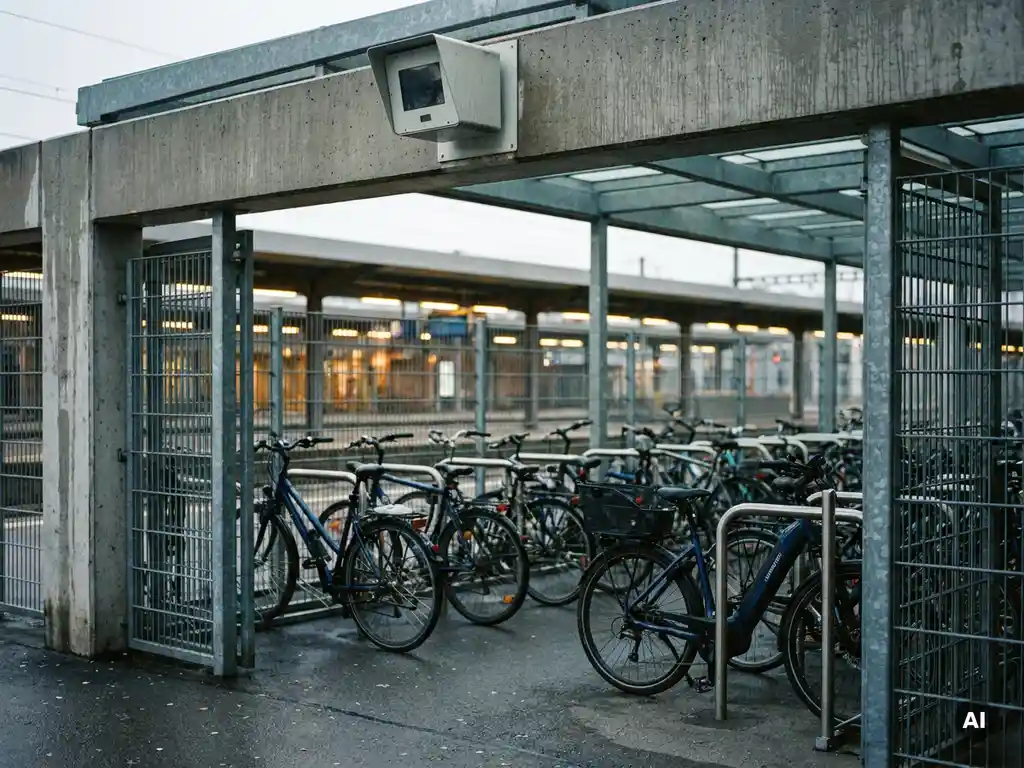
How do you secure bicycle parking facilities at public transport?
Bicycle parking facilities at public transport stations can be effectively secured through a combination of access control, camera surveillance, and, where necessary, guarded personnel. The right approach depends on the size of the facility, the location, and the risk profile. For those seeking immediate advice on a specific situation, you can contact with a security specialist. In this article, we answer the most frequently asked questions about securing public transport bicycle parking facilities.
Which security measures are effective for bicycle parking facilities?
Effective security for bicycle parking facilities rests on three pillars: physical barriers, electronic access control, and surveillance. No single measure works optimally on its own. A combination of fencing or barriers, camera systems, and potentially staff offers the most protection against theft and vandalism.
In practice, these are the most frequently applied measures:
- Physical separation such as fences, gates, or barriers that block unwanted access
- Electronic access control via OV-chipkaart, pass, or app that only allows authorized users entry
- Camera surveillance that acts as both a deterrent and provides evidence in the event of incidents
- Relief which eliminates dark corners and strengthens social control
- Guarded personnel at busy junctions where the risks are highest
The effectiveness of each measure increases when multiple layers are combined. A well-lit parking facility with access control and cameras is significantly safer than a location with only one of these elements.
What are the most common risks at public transport bicycle parking facilities?
The most common risks at public transport bicycle parking facilities are bicycle theft, vandalism, and the unauthorized abandonment of vehicles. Bicycle theft is by far the biggest problem, especially at busy stations where large numbers of bicycles are left unattended daily. Vandalism and damage to bicycles or the infrastructure come in second place.
In addition to theft and vandalism, there are also operational risks:
- Abandoned bicycles which block the parking area and cause capacity problems
- Abuse of space by people using the parking facility for other purposes
- Fire risk for e-bikes with lithium batteries that are charged incorrectly
- Social insecurity in remote or poorly lit locations, especially in the evening hours
The risk profile varies significantly by location. A large parking facility at an intercity station presents different challenges than a smaller facility at a bus stop in a residential area. A risk analysis is therefore the logical first step when setting up a security plan.
How does access control work at a guarded bicycle parking facility?
Access control at a guarded bicycle parking facility operates via a system that grants access only to registered users. Travelers identify themselves using a public transport chip card, a personal pass, or a mobile application. A gate or barrier opens automatically after verification, after which access is registered in a central system.
Modern access control It offers more than just opening or closing a door. The system records who enters and leaves the parking facility, at what time, and for how long a bicycle is parked. This makes it possible to identify abandoned bicycles, monitor capacity, and consult an accurate logbook in the event of incidents.
In guarded parking facilities, access control works in conjunction with the staff present. The employee can intervene if a pass does not work, if there is a technical problem, or if someone attempts to bypass access. The combination of technology and human supervision makes this system robust and reliable.
What is the difference between guarded and unguarded stabling?
The difference between guarded and unguarded storage lies in the presence of staff actively monitoring. At a guarded facility, an employee is present who controls access, monitors, and can intervene in the event of incidents. At an unguarded facility, security relies entirely on technical means such as locks, cameras, and access gates.
Guarded bicycle parking
A guarded parking facility offers the highest level of security. Staff act as a visible deterrent, assist users, and respond immediately to problems. Parking facilities at major hubs such as Amsterdam Central or Utrecht Central are almost always guarded, partly due to the enormous number of bicycles and the value of the parked vehicles.
Unattended bicycle parking
Unattended parking facilities are more cost-effective and suitable for locations with a lower risk profile. They rely on good technical infrastructure: sturdy bicycle racks, lighting, camera systems, and possibly electronic access gates. The disadvantage is that an immediate response is not possible in the event of an incident and that the threshold for misuse is slightly lower.
The choice between the two forms depends on the expected usage, the budget, and the local security situation. In many cases, a hybrid approach is effective: staff present during the day, and fully technically secured in the evening and at night.
What role does camera surveillance play in securing bicycle parking facilities?
Camera surveillance plays a dual role in securing bicycle parking facilities: it has a preventative effect as potential thieves avoid visible cameras, and it provides evidence should an incident occur. Cameras are therefore one of the most cost-effective security measures for parking facilities of any size.
A number of practical principles apply to an effective camera system:
- Full coverage of the entrances and exits so that every visitor is registered
- Sufficient resolution to capture faces and license plates recognizably
- Good lighting or night vision cameras for usable images in the dark
- Clear signage indicating camera surveillance, which enhances the deterrent effect
- Secure storage of image material in accordance with privacy legislation
Camera surveillance works best as part of a broader security system. Cameras alone, without access control or monitoring, offer limited real-time protection. However, in combination with other measures, they form an indispensable link in the security of any bicycle parking facility.
When is professional security necessary for a bicycle storage facility?
Professional security is necessary when the size of the facility, the risk profile, or the value of the stored vehicles exceeds the capabilities of purely technical measures. At facilities with hundreds or thousands of spaces, at locations with a high incident frequency, or at facilities for more expensive vehicles such as e-bikes, professional security personnel are not a luxury but a necessity.
Concrete situations in which professional security is recommended:
- Major public transport hubs with a high daily throughput of users
- Locations where multiple thefts or acts of vandalism have previously occurred
- Parking facilities that are also in use at night and where social insecurity is an issue
- Opening periods of new storage facilities where usage and risks are still unknown
- Temporary situations such as events where normal use temporarily increases sharply
Professional security does not necessarily mean that someone must always be physically present. By 2026, there will also be solutions where a control room monitors remotely via camera systems and can intervene immediately or sound an alarm. This offers an effective alternative for locations where permanent presence is not feasible. Would you like to know which approach best suits your bicycle parking facility? Contact us for a no-obligation consultation.
Frequently Asked Questions
How do I start drafting a security plan for a bicycle storage facility?
Start with a thorough risk analysis of the location: map out the size of the storage facility, analyze expected usage, opening hours, and any previous incidents. Based on this, develop a layered security plan that combines physical, electronic, and potentially personnel measures. A security specialist can assist with this by combining a site visit with a tailored consultation.
What mistakes are made most often when securing a bicycle parking facility?
The most common mistake is relying on only a single security measure, such as just cameras or just a fence, without combining it with additional layers. Additionally, lighting is frequently underestimated: poorly lit corners significantly increase the risk of theft and social insecurity. Another common mistake is the lack of a clear protocol for dealing with abandoned bicycles and incidents, causing problems to accumulate without an adequate response.
Is an OV-chipkaart always required for access control, or are there alternatives?
No, an OV-chipkaart is not the only option. In addition to the OV-chipkaart, there are systems that work with a personal RFID card, a PIN code, or a mobile app via Bluetooth or QR code. The choice depends on the target group and the existing infrastructure: at public transport hubs, the OV-chipkaart aligns seamlessly with users' travel behavior, while an app-based solution may be a better fit for newer, standalone parking locations.
How do I deal with the fire risk of e-bikes with lithium batteries in a bicycle storage area?
The fire risk of e-bikes requires specific measures, such as designating separate charging points with fire-safe charging infrastructure and placing smoke detectors and fire extinguishers at strategic points in the storage area. Also consider the use of fire-resistant partitions or zones for e-bikes. Actively inform users about the rules regarding charging and ensure that staff or the control room can intervene immediately in the event of a fire alarm.
What are the privacy rules regarding camera surveillance in a bicycle storage facility?
Camera surveillance in bicycle parking facilities must comply with the General Data Protection Regulation (GDPR). This means that you must have a legitimate purpose for the recording, clearly inform visitors via signs that filming is taking place, and may not retain footage for longer than necessary — generally a maximum of four weeks. If in doubt, consult a legal advisor or the Dutch Data Protection Authority for specific guidelines applicable to your situation.
Can a small bicycle parking facility at a bus stop also be effectively secured with a limited budget?
Yes, even with a limited budget, effective measures are possible. Prioritize good lighting and sturdy bicycle racks as a base layer, and add visible camera signs as a deterrent — even if the cameras are monitored remotely via an affordable cloud solution. A simple entrance gate combined with clear signage can already make a significant difference in the risk profile of a smaller location.
How often should a security system for a bicycle storage facility be evaluated or updated?
A security system deserves a thorough evaluation at least once a year, but also after every significant incident or when there are changes in the use of the parking facility. Consider an increase in the number of e-bikes, an expansion of capacity, or changed opening hours. Technological developments are rapid, meaning that systems that were modern a few years ago may now exhibit shortcomings that can easily be remedied with an update or expansion.