How do you prevent losing keys?
You can prevent losing keys by creating a designated storage location, using smart tools, and maintaining a clear routine. Most people do not lose their keys due to inattention, but due to the lack of a system. Moreover, for companies and organizations, it applies that good access control is indispensable for managing keys systematically. In this article, we answer the most frequently asked questions about preventing key loss, from handy tools to professional solutions. Do you have a question right away? Feel free to contact us with Sellox.
Where do people lose their keys most often?
People lose their keys most often in and around their own homes: in coats, bags, between cushions, or in a place where they put them down without consciously thinking about it. Research into daily habits shows that most searches begin at the front door, the sofa, and the kitchen.
The most common places where keys get lost are:
- In coat pockets or handbags
- Between or under sofa cushions
- On the counter or the kitchen table
- In the car, on the passenger seat, or in the glove compartment
- In the trouser pocket of clothes that are already in the wash
The pattern is almost always the same: keys are put down in a random place upon returning home, without a fixed routine. As soon as you are in a rush the next day, the searching begins. This problem is easy to solve with a system, but most people wait until things go wrong before taking action.
What tools help to find keys?
Bluetooth trackers, such as keychains with GPS or Bluetooth functionality, are the most effective tools for finding lost keys. Using a corresponding app on your smartphone, you can track the location of your keys or activate an audible signal to hear them.
The most popular options are:
- Bluetooth trackers: Small devices that you attach to your keychain and can locate via an app. They work well indoors and in the immediate vicinity.
- Keychains with sound signal: Simple versions that respond to a whistle signal or a press of a remote control.
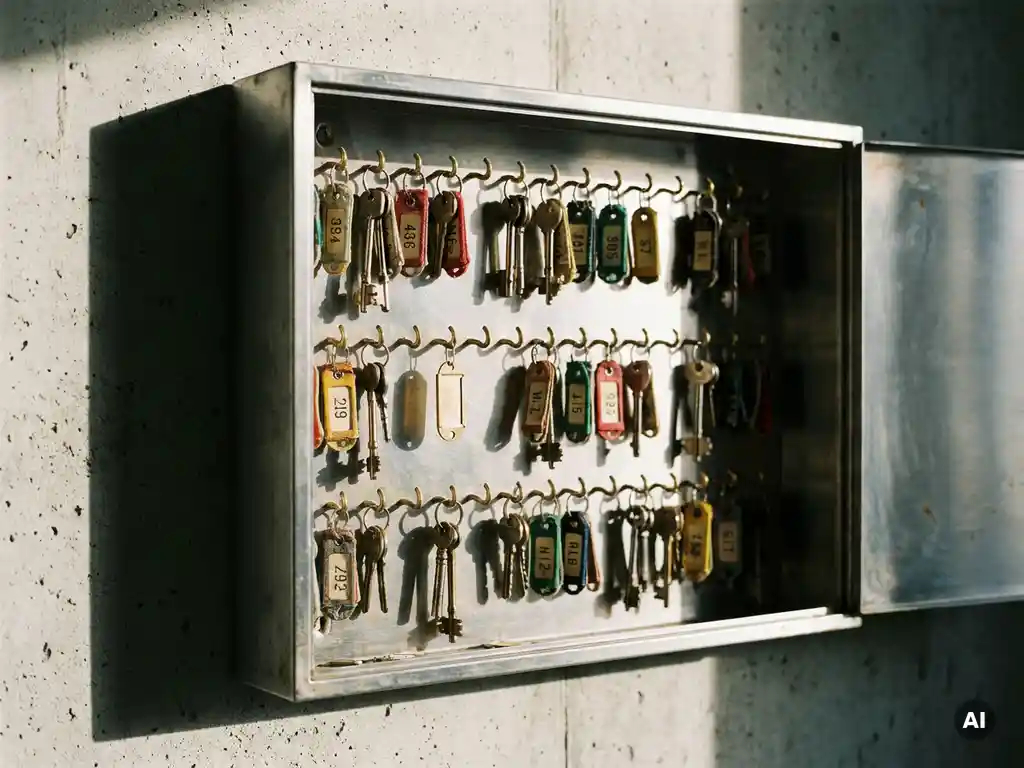
- Smart key cabinets: Lockers that keep track of when keys are collected or returned, useful for multi-person households or small businesses.
For home use, a Bluetooth tracker is sufficient. For companies or institutions where multiple people have access to keys, more advanced key management systems are a better choice. These systems automatically record who took which key and when.
How do you create a designated place for your keys?
You create a designated place for your keys by setting up a clearly designated storage spot by the front door and training yourself to always place the keys there immediately upon returning home. Consistency is more important here than the tool itself.
Practical ways to set up a fixed spot:
- Key hook by the front door: Attach a hook or a small panel directly next to the front door so that hanging up keys becomes an automatic action.
- Key cabinet: A locked cabinet offers more overview and security, especially if there are multiple keys in the house.
- Fixed bag or backpack: If you always use the same bag, there is always the same place for your keys. If you switch bags regularly, this is less reliable.
- Visual memory: Stick a sticker or note on the inside of the front door as a reminder until the habit is ingrained.
The most important principle is that the storage place is as close to the front door as possible. The further you take the keys into the house, the greater the chance that you will put them down in a random place.
What do you do if you lose your keys anyway?
If you have lost your keys, first systematically search the most likely places: coat pockets, bags, the front door, and frequently used surfaces. Then, use a tracker app if you have a Bluetooth tracker. If the keys are not recovered, it is advisable to have the lock replaced.
Follow these steps in case of key loss:
- Check all coats, bags, and pockets that you used yesterday.
- Check all the places where you usually put things down when you get home.
- Use your Bluetooth tracker's app if you have one.
- Ask people around you if they have seen the keys lying around anywhere.
- Report the loss to the municipality or a lost and found service if you suspect the keys were lost outside.
- Consider having the lock replaced if you cannot find the keys and do not know where they are. This prevents unauthorized persons from gaining access to your home or business.
Losing keys is not only inconvenient but can also pose a security risk. This is especially true if the keys have an address label or if they concern keys to business premises; acting quickly is essential.
When is a key safe or key management system useful?
A key safe or professional key management system makes sense whenever multiple people need access to the same keys, or when the loss of a key has direct consequences for the security of a building or organization. For private individuals, a simple safe is often sufficient; for businesses, an automated system is the better choice.
Situations where a key safe or management system offers added value:
- Landlords and property managers: Multiple keys for multiple properties require a structured method of management and issuance.
- Healthcare institutions and schools: Employees regularly change shifts and must hand over keys without causing confusion.
- Companies with secure areas: When it is important to keep track of who had access and when, a digital management system offers a complete record.
- Private individuals with a second home or Airbnb: A key safe by the front door makes it possible to safely share keys without being personally present.
A well-designed key management system is part of a broader approach to access control. It not only provides an overview but also significantly reduces the risk of misuse or unauthorized access. Would you like to know which solution best suits your situation? Contact us with Sellox for personal advice.
Frequently Asked Questions
How long does it take for hanging keys in a fixed place to become an automatic habit?
On average, it takes between 21 and 66 days for a new habit to feel fully automatic, depending on the person and the consistency with which you apply the routine. You can speed this up by using visual reminders, such as a sticker on the front door, and by consciously rewarding yourself when you put the keys in the right place. After a few weeks of consistent behavior, you will notice that you no longer have to think about it.
Which Bluetooth tracker is best for keeping track of keys?
Popular and reliable options include the Apple AirTag (ideal if you already use an iPhone), the Tile Mate, and the Samsung SmartTag. The choice depends mainly on the type of smartphone you use: AirTags work best within the Apple ecosystem, while Tile trackers are platform-independent and therefore also work well with Android. When purchasing, pay attention to the range, battery life, and whether the tracker is easy to attach to a keychain.
What are the most common mistakes when setting up a key management system for businesses?
The most common mistake is purchasing a system without clear usage protocols: who is allowed to take which key, how is this registered, and who is responsible for management? A second common mistake is underestimating the number of keys that need to be managed, causing the system to quickly prove too small. Always ensure that employees are trained in the use of the system and that a designated administrator is assigned.
Is it wise to keep a spare key outside, for example under a flowerpot?
Storing a spare key in a predictable outdoor location, such as under a flowerpot or doormat, is strongly discouraged because this is a known and easy target for burglars. A safer alternative is to keep a spare key with a trusted person, such as a neighbor or family member. For those who do not have a trusted person nearby, a certified key safe with a numerical code attached to the facade offers a safe and practical solution.
When is it mandatory to replace a lock after losing the key?
There is no legal obligation to replace a lock after losing keys, but it is strongly recommended as soon as you do not know where the keys have gone and there is a real risk that unauthorized persons could use them. Tenants are required to inform the landlord of lost keys to a business or rental property, as the landlord may be required to take action. Companies with secure areas or sensitive information would be wise to always treat this as a security incident and have the lock replaced immediately.
Can a key management system also be linked to other security systems in a building?
Yes, in many cases, modern digital key management systems can be integrated with other security systems such as access control systems, alarm systems, and camera surveillance. This makes it possible to obtain a complete overview of who had access to which room and when, and to quickly detect anomalies. Sellox is happy to advise you on the options that suit your organization's specific situation and infrastructure.
What is the difference between a key safe and a professional key management system?
A key safe is a physical, often simple solution for securely storing one or more keys, typically protected by a numerical code or lock — ideal for private individuals or small situations such as an Airbnb. A professional key management system is an automated solution that records who took which key, when this occurred, and when the key was returned, often linked to a software platform with reporting capabilities. For organizations where multiple employees work with keys daily, a professional system offers significantly more control, security, and overview.