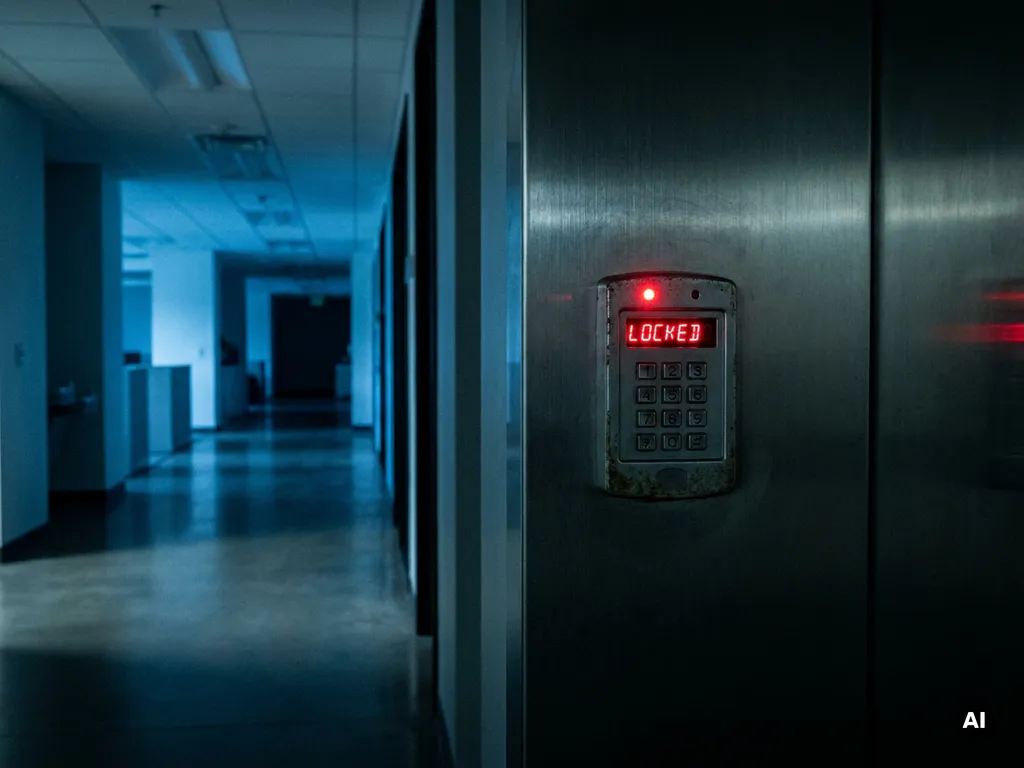
How do you prevent unauthorized access outside working hours?
Unauthorized access outside working hours can be prevented through a combination of electronic access control, time-based authorizations, camera surveillance, and clear protocols. No single measure offers complete protection: the strength lies in the combination of technical systems and organizational measures. In this article, we answer the most frequently asked questions about securing premises outside regular working hours. Do you have immediate questions about your specific situation? Feel free to contact us with Sellox.
What risks arise outside regular working hours?
Outside working hours, premises are more vulnerable to burglary, theft, vandalism, and unauthorized access by their own employees or third parties. Without supervision and without colleagues present, unwanted activity is less likely to be noticed. This makes the evening, night, and weekend the periods with the highest security risk for most companies.
The risks are not exclusively external. Internal threats also play a role: an employee who has access to a server room, archive, or warehouse outside of their authority can cause damage, whether intentionally or unintentionally. Furthermore, there are situations where contractors, cleaning staff, or suppliers require access while there is no internal supervision.
Good access control-measures focus on both dimensions: they keep unauthorized persons out and restrict the freedom of movement of persons from within to what is strictly necessary.
Which access control systems protect a building outside working hours?
The most commonly used access control systems outside working hours are electronic locks with cards or PIN codes, biometric readers, key management cabinets, and integrated access platforms. These systems record who had access and when, and automatically block anyone who is not authorized for a specific time or area.
Several factors play a role in the choice of a system:
- Scale: A small office has different needs than a large distribution center with multiple entrances.
- Integration: Modern systems link access control to alarm systems and camera surveillance in a single platform.
- Remote management: Cloud-based systems make it possible to revoke or grant rights remotely, even outside office hours.
- Audit trail: Each system must maintain a log of access attempts, including failed attempts.
A good access control system is not a static lock, but a dynamic instrument that moves with the organization.
How does time-based access work with electronic locks?
Time-based access means that an electronic lock or access card only works within a pre-set time window. Outside that window, access is automatically denied, even if the card or code is valid. This makes it possible to grant someone access, for example, only on workdays between 07:00 and 19:00, without manual intervention.
In practice, you set up time profiles via management software. For each employee, contractor, or supplier, you define which rooms are accessible at which times. If someone's position changes or a contract ends, you adjust the profile and access is revoked immediately. This prevents former employees or hired staff from retaining access after the completion of their assignment.
Time-based access is also valuable for temporary situations: a cleaning company that only needs access on Monday mornings, or a technician who needs to fix a malfunction just once. You grant exactly the access that is needed, for exactly the period that is needed.
What is the difference between camera surveillance and alarm systems?
Camera surveillance records what happens and serves as evidence afterwards, whereas an alarm system responds immediately to an unwanted situation and emits a signal to initiate further action. Both systems complement each other, but have a fundamentally different purpose and function differently.
Camera surveillance: visible monitoring and recording
Cameras have a preventive effect because they are visibly present: potential intruders are deterred. At the same time, they capture images that can be used later for investigations or filing a report. Modern camera systems offer motion detection capabilities and can automatically send a notification in the event of suspicious activity. However, camera surveillance is reactive in nature: the camera detects, but does not intervene.
Alarm systems: immediate response to burglary
An alarm system detects unauthorized access via sensors such as motion detectors, door contacts, or glass break detectors. Upon activation, an alarm follows immediately, which is audible locally and simultaneously forwarded to a monitoring center or security service. The alarm significantly shortens response time, limiting the risk of damage or theft. An alarm system works best in combination with camera surveillance and access control.
When is a security service necessary in addition to technical measures?
A security service is necessary when technical systems alone are insufficient to manage risks, or when a situation requires human judgment and immediate physical presence. Consider premises with a high-risk profile, large sites, or situations where an alarm must be responded to quickly and professionally.
Technical measures register and signal, but do not take action. A security guard can assess the situation on the spot, de-escalate it, notify the police, or provide first aid. This makes human surveillance irreplaceable in a number of scenarios:
- Properties with high storage value or sensitive information
- Locations with multiple entrances that are difficult to monitor technically
- Events or temporary situations outside regular working hours
- Environments where the risk of aggression or confrontation is real
In many cases, a hybrid approach is most effective: technology monitors continuously and cost-effectively, while a security service responds to situations requiring human intervention.
How do you set up an effective protocol for access outside working hours?
An effective protocol for access outside working hours describes who is authorized to have access to which areas and at what times, and how access is requested, approved, and revoked. The protocol also specifies what happens in the event of an incident: who is called, what steps are taken, and how is it reported?
A good protocol contains at least the following elements:
- Authorization matrix: an overview of functions and the associated access rights per room and time window.
- Application procedure: A clear route for applying for temporary or exceptional access, including the approval process.
- Withdrawal procedure: agreements regarding the immediate revocation of access upon termination of employment, change of position, or incident.
- Incident protocol: contact details of the control room, security service, and internal supervisors, including escalation lines.
- Periodic evaluation: a fixed frequency at which the protocol and access rights are checked and updated.
A protocol is only effective if it is actually followed. Ensure employee training and clearly define responsibilities. Combine this with the right technical systems, and you have a solid foundation for secure access outside working hours. Would you like to know how Sellox can support your organization with this? Contact us and we are happy to think along with you.
Frequently Asked Questions
How do I know which access control system best suits my business premises?
The choice depends on factors such as the size of the premises, the number of users, the existing risks, and the desired ease of management. Start with a risk analysis: which areas are sensitive, who needs access, and how often? Based on that analysis, a supplier like Sellox can recommend a suitable system that aligns with your specific situation and budget.
What do I do if an employee loses their access card outside working hours?
With a cloud-based access control system, you can immediately block a lost card remotely, even outside office hours. Therefore, ensure that a responsible person with administrative access to the system is always available. Document in your protocol who this person is and how employees can reach him or her in the event of a card being lost or stolen.
Am I allowed to simply install camera surveillance in and around my business premises?
Camera surveillance is permitted in the Netherlands for legitimate purposes such as security, but you are required to comply with the GDPR (General Data Protection Regulation). This means, among other things, that you must inform employees and visitors about the presence of cameras, that footage may not be retained longer than necessary, and that you maintain a processing register. If in doubt, consult a legal advisor or the Dutch Data Protection Authority.
How do I prevent former employees or ex-contractors from still having access to the premises?
Revoking access rights must be a standard part of the offboarding process and take place immediately on the last working day, or sooner in the case of summary dismissal. Use an electronic access control system that allows you to deactivate rights with a single action, and link this process to HR procedures so that no step is skipped. Periodic audits of active access rights help to detect forgotten accounts or expired contracts in a timely manner.
What are the most common mistakes made when securing a property outside working hours?
The most common mistakes are: relying on a single security measure (such as only an alarm), failing to keep access rights up to date, not having a clear incident protocol, and insufficiently training employees on applicable procedures. The internal threat is also often underestimated: not only external intruders, but also employees with overly broad access rights pose a risk. A layered approach involving both technical and organizational measures prevents most of these pitfalls.
How often should I evaluate my security protocol and access rights?
A minimum evaluation frequency of twice a year is recommended, but for fast-growing organizations or those with frequently changing staff, a quarterly check is more sensible. Also, link evaluations to specific moments, such as the end of a major project, a reorganization, or a security incident. In doing so, check not only the protocol itself but also the actual access logs to identify deviations or unusual patterns.
Is a hybrid approach combining technology and a security service always necessary, or is technology alone sufficient?
For many SMEs with a low to medium risk profile, a well-configured technical system (access control, camera surveillance, and an alarm connected to a monitoring center) offers sufficient protection. Physical security services only become truly necessary with a high risk profile, for large or complex sites, or when a rapid physical response on-site is required. Have your risk profile professionally assessed to determine which combination is cost-effective and adequate for your situation.