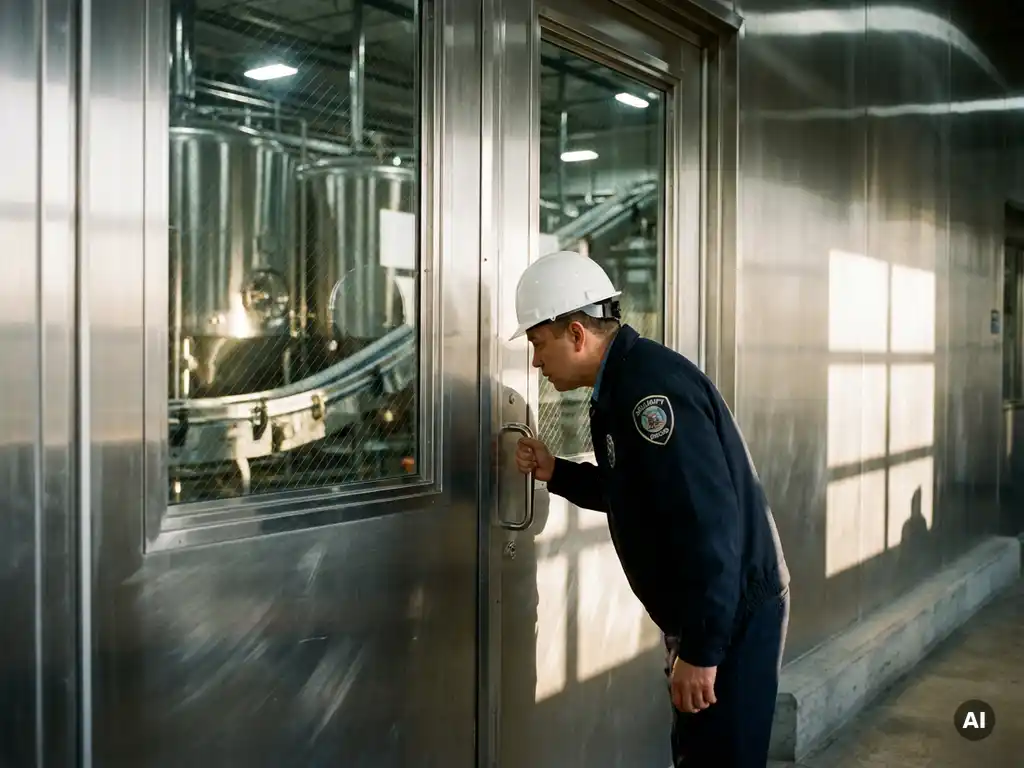
How do you secure a food factory?
You secure a food factory through a combination of access control, camera surveillance, intrusion detection, and internal procedures that counter both external threats and internal abuse. The security of a food company is more complex than that of a standard business premises, because you are dealing not only with theft and burglary, but also with product safety, hygiene protocols, and legal requirements. In this article, we answer the most frequently asked questions about the security of food factories. Would you like immediate, tailored advice? Feel free to contact us with Sellox.
Which security risks are specific to food factories?
Food factories are exposed to a unique combination of risks: in addition to conventional threats such as burglary and theft, product tampering, contamination, and sabotage pose specific dangers rarely encountered in other industries. Because food directly impacts public health, security incidents can have far-reaching consequences for consumers, the company, and a brand's reputation.
The main risks are:
- Product tampering: intentional contamination or manipulation of food products by malicious persons from within or outside the company.
- Theft of raw materials or finished products: Food has direct market value and is therefore attractive to thieves.
- Burglary and vandalism: Factories are often less staffed at night, which makes them vulnerable to intruders.
- Internal fraud: Employees with access to production areas can cause damage, whether intentionally or unintentionally.
- Hygiene contamination due to unauthorized access: Persons without proper hygiene measures in production areas can jeopardize food safety.
The unique aspect of food factories is that a security incident is rarely limited to financial damage. A recall or a food safety scandal can haunt a company for years.
Which access control measures are suitable for a food factory?
Effective access control In a food factory, this consists of a layered system whereby only authorized persons are granted access to specific zones, tailored to their function and hygiene class. This prevents both external intruders and the unwanted presence of employees in areas where they have no business being.
Suitable measures are:
- Electronic access passes or badges: Each employee receives a unique pass that grants access only to the zones associated with his or her function.
- Biometric access control: Fingerprint or facial recognition offers a high level of security, ideal for sensitive production areas.
- Lock systems (mantrap): A double door, where the first door must close before the second opens, prevents multiple people from entering at the same time.
- Visitor registration: All visitors are registered, provided with a temporary pass, and escorted by an employee.
- Zoning: dividing the site into zones with rising access levels, from public areas to enclosed production spaces.
Zoning is particularly relevant in food factories because hygiene zones and security zones often overlap. A good access control system supports both objectives simultaneously.
How do you protect a food factory against burglary and vandalism?
You protect a food factory against burglary and vandalism through a combination of physical barriers, camera surveillance, and alarm systems that both deter and enable rapid intervention. No single measure is sufficient on its own; the strength lies in the combination.
Concrete measures include:
- Fences and railings: A clear physical perimeter keeps unauthorized persons at bay and makes the premises more difficult to enter.
- Outdoor lighting and motion sensors: Well-lit areas deter and make camera footage more usable.
- IP camera systems: Modern cameras with high resolution and night vision provide continuous surveillance of the grounds and buildings.
- Intrusion detection systems: Motion detectors, vibration sensors, and door contacts trigger an immediate alarm upon unauthorized access.
- Control room connection: By connecting the alarm system to a professional monitoring center, incidents can be responded to quickly 24/7.
Prevention starts with visibility. A site that looks professionally secured is less attractive to opportunistic burglars or vandals.
What are the legal security requirements for the food industry?
The food industry is subject to European and national regulations that indirectly establish security requirements through food safety standards. The main frameworks are EU Regulation 178/2002 (General Food Regulation), the HACCP guidelines, and certifications such as BRC, IFS, and FSSC 22000, all of which set requirements for access control and the protection of production areas.
What this means in practice:
- HACCP: Companies are required to identify and control risks in the production process, including risks due to unauthorized access.
- BRC Global Standard for Food Safety: requires demonstrable measures for the security of production areas, including access control and camera surveillance.
- IFS Food: sets requirements for the physical security of the site and the registration of visitors and suppliers.
- FSSC 22000: integrates food safety and food defense, whereby deliberate sabotage or contamination is explicitly included as a risk.
Failure to comply with these standards can lead to the loss of certifications, fines, or even a production stoppage. Security in the food industry is therefore not only an operational choice but also a legal obligation.
How do you prevent internal theft and product tampering in a food company?
Internal theft and product tampering are prevented by a combination of strict access control, camera surveillance at critical points, and clear internal procedures that make employees aware of their responsibilities. Trust is valuable, but verification is necessary.
Effective measures are:
- Separation of functions: Ensure that no single employee has full control over a critical process without the supervision of a colleague.
- Camera surveillance at critical points: Production and storage areas, loading docks, and lockers deserve extra attention.
- Access logging: Digital systems automatically record who entered which room and when, which simplifies investigations after an incident.
- Periodic checks and sample checks: Regular inventory checks make discrepancies quickly visible.
- Reporting culture: Employees must be able to report suspicions of fraud or tampering without fear of reprisals.
Product tampering is a particularly serious risk because it is difficult to detect and can cause significant damage. Packaging integrity checks and sealed storage areas are additional measures that specifically help prevent this.
Which security technologies are most effective in the food industry?
The most effective security technologies for food factories are systems that record access, automate surveillance, and respond quickly to incidents, such as IP camera systems, electronic access control, and integrated alarm systems with monitoring center connectivity. The choice depends on the size of the company, the layout of the site, and the specific risks.
Camera surveillance and video analysis
Modern IP cameras offer not only live footage but also smart video analysis that automatically alerts to suspicious behavior, such as individuals in a restricted area or vehicles entering the premises outside office hours. This reduces reliance on manual surveillance.
Electronic access control
Electronic access systems register every movement through the premises and make it possible to adjust access rights remotely and in real time. For food companies, this is particularly valuable because visitors, suppliers, and temporary employees can easily be granted temporary and limited access without compromising security.
Integrated security platforms
Most modern security systems can be integrated into a single platform, where cameras, access control, and alarms work together. This provides security managers with a complete overview and significantly accelerates response times to incidents.
Effective security for your food factory is not a one-time investment, but an ongoing process that requires the right combination of technology, procedures, and employee awareness. Whether you are just starting to set up a security plan or want to improve an existing system, professional advice makes all the difference. Contact us Contact Sellox for a no-obligation consultation about the security of your location.
Frequently Asked Questions
How do I start drafting a security plan for my food factory?
Start with a thorough risk analysis in which you map out all access points, vulnerable zones, and potential threats. Combine this with an inventory of your current security measures to identify the gaps. Based on this, you can set priorities and invest in the right technology and procedures in phases. A specialized security company can assist you with this analysis and develop a customized plan.
How do I handle the security of external suppliers and drivers entering my factory?
Establish a clear supplier protocol requiring all external visitors to report to a reception or porter's lodge, be registered, and receive a temporary access pass with limited validity. Assign a designated escort to escort the supplier or driver to the loading zone and never leave them unattended in production-sensitive areas. Electronic access systems make it easy to automatically set and revoke temporary and location-based access rights.
What is the difference between food safety and food defense, and why is that relevant to my security?
Food safety focuses on preventing the unintentional contamination or hazards in the production process, whereas food defense specifically focuses on protecting food against intentional sabotage, tampering, or terrorism. This distinction is important for security policy: food safety is ensured through hygiene and process control (HACCP), while food defense requires targeted security measures such as access control, camera surveillance, and employee background screening. Certifications such as FSSC 22000 require that both aspects are demonstrably secured.
How often should I have my security systems and procedures checked or updated?
Security systems and procedures must be thoroughly evaluated at least once a year, but also after every security incident, renovation, organizational change, or the introduction of new employees. Technical systems such as camera software and access control software require regular firmware and software updates to patch vulnerabilities. Periodic penetration tests and unannounced internal audits help discover weaknesses before a malicious actor does.
Can small food companies also benefit from advanced security technology, or is that reserved only for large factories?
Advanced security technology is now also highly accessible and affordable for small and medium-sized food businesses. Scalable IP camera systems, cloud-based access control software, and affordable alarm systems with monitoring center integration are available in configurations that grow with your business. Even a smaller investment in the right combination of measures offers a significant improvement in security and can help obtain or maintain food safety certifications.
What should I do if a security incident occurs in my food factory?
Ensure you have prepared an incident response plan in advance with clear steps: secure the location, inform the responsible employees, and call the police if necessary. In the event of suspected product tampering or contamination, it is crucial to immediately isolate the affected production batch and inform the quality department and, if applicable, the Netherlands Food and Consumer Product Safety Authority (NVWA). Document everything accurately using logbooks and camera footage so that you can analyze the incident and prevent recurrence.
How do I ensure that my employees remain security-aware without negatively impacting the work atmosphere?
Security awareness begins with good onboarding, where new employees are immediately informed about the importance of security and their own responsibilities in this regard. Organize periodic, short training sessions or toolbox meetings that are practical and relevant to daily work, and communicate security updates in a positive and transparent manner. A culture in which employees feel jointly responsible for the security of the company and its products—rather than being monitored or distrusted—ensures lasting security awareness without harming the work atmosphere.