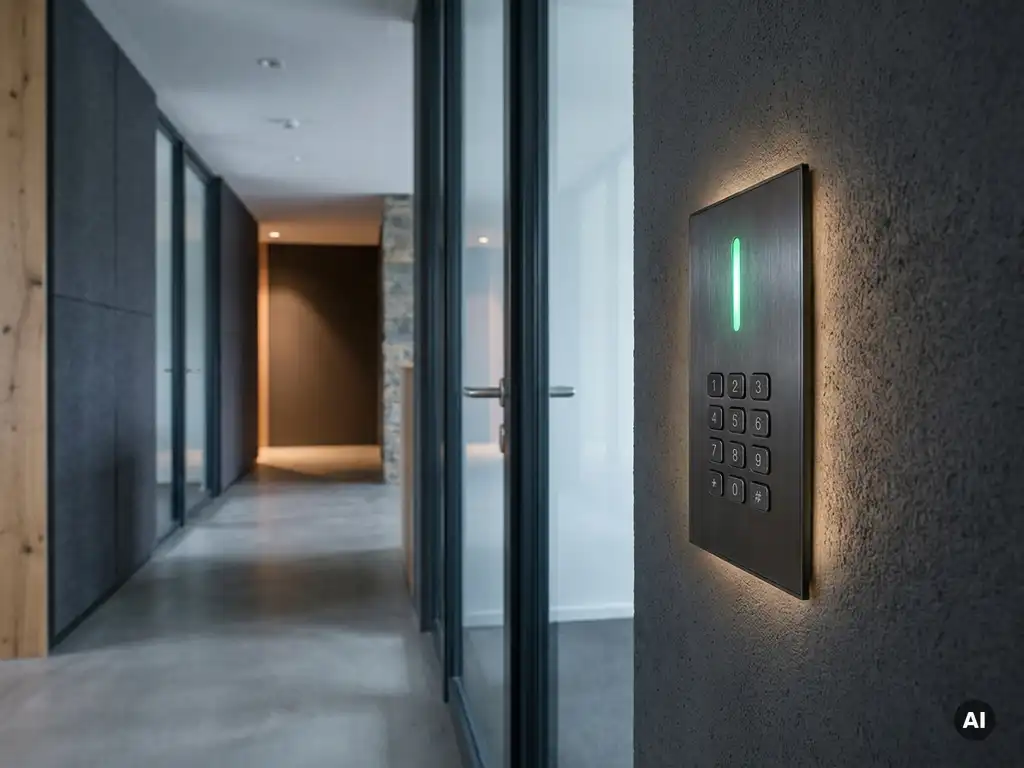
What is an access control system?
An access control system is a security solution that allows an organization to determine who has access to specific areas, systems, or information, and at what time. The system registers, manages, and monitors individuals' access rights based on predefined rules. Do you have questions about what best suits your situation? You can always contact with our specialists. In this article, we answer the most frequently asked questions about access control systems.
How does an access control system work in practice?
An access management system works by linking a person's identity details to predefined access rights. When someone registers at a door or gate, the system reads the identity via a card, PIN code, or biometric characteristic, compares this with the database, and automatically grants or denies access.
In practice, this process works as follows: an employee holds their access card in front of a reader at the entrance. The system checks whether the card is linked to a profile with the correct permissions for that location and time. If so, the door opens. If not, the door remains closed and the attempt is logged.
Administrators can use software to set, modify, or revoke the rights of each user. This allows a new employee to gain immediate access to the relevant areas, while a departing employee can be blocked with a single action. All access attempts are stored in a logbook, which is valuable for audits and incident investigations.
What types of access control systems are there?
There are three main types of access control systems: role-based access control (RBAC), rule-based access control, and discretionary access control (DAC). The choice depends on the size of the organization, the security level, and the degree of flexibility required.
Role-based access control (RBAC)
With RBAC, employees are granted access based on their position or role within the organization. A warehouse worker has different rights than a director. This model is easy to manage in larger organizations because rights are set per role, not per individual.
Discretionary Access Control (DAC)
With a DAC, the owner of a room or system determines who has access to it. This offers a great deal of flexibility but can also lead to inconsistent security if there is no central control. This model is used more often in smaller environments.
What is the difference between access management and access control?
Access management refers to the broader process of defining, assigning, and managing access rights. Access control is the technical mechanism that enforces those rights when someone attempts to enter somewhere. Access management is the policy; access control is the execution thereof.
A practical example: the decision that only employees of the finance department may have access to the server room falls under access control. The reader at the door who accepts or rejects a pass is the access controller. Both elements are necessary for a properly functioning security system.
In practice, the terms are used interchangeably, but the distinction is relevant when designing a system. Good. access control It starts with a clear policy regarding who has access to what, before technology is deployed to enforce that policy.
Which technologies are used in access control systems?
Access control systems utilize various technologies, depending on the desired level of security. The most commonly used are RFID cards, PIN codes, mobile access via smartphones, and biometric recognition such as fingerprint or facial recognition.
- RFID and smartcards: The most common technology for physical access control. Compact, reliable, and easy to manage.
- Mobile access: Employees use their smartphone as an access method via Bluetooth or NFC. This is convenient because smartphones are almost always at hand.
- Biometrics: Fingerprint, iris recognition, or facial recognition offer a high level of security because they are non-transferable.
- PIN codes: Simple and cheap, but less secure because codes can be shared or observed.
- Cloud-based systems: Access control systems are increasingly managed via the cloud, enabling remote management and scalability.
Modern systems often combine multiple technologies for extra security, for example, a card combined with a PIN code or biometric feature. This is called multi-factor authentication.
When do you need an access control system?
An access control system is necessary as soon as an organization has multiple employees, works with sensitive information or areas, or is required to comply with security standards. A structured system is also indispensable in cases of growth, multiple locations, or fluctuating staffing.
Concrete situations where an access control system is strongly recommended:
- Organizations with multiple departments or floors where not everyone is allowed everywhere
- Companies that work with personal data and must comply with the GDPR
- Environments with rotating staff, temporary workers, or visitors
- Locations that must be accessible outside office hours without permanent surveillance
- Organizations that need an audit trail of who was where and when.
Even for smaller businesses, a simple system can offer significant value. It is not just about preventing theft or burglary, but also about being able to account for who had access to which room.
How do you choose the right access control system?
You choose the right access control system based on the size of your organization, the desired security level, the number of locations to be secured, and your budget. Start by making an inventory of which areas need to be secured and who requires access to them.
Take the following factors into account when making your choice:
- Scalability: Can the system scale with your organization as it grows or new locations are added?
- Integration: Does the system work with existing security systems such as camera surveillance or alarm systems?
- Ease of management: How easy is it to modify permissions, add or remove users?
- Technology: Which identification method suits the work environment and the users?
- Support and maintenance: Is there a reliable party available for installation, updates, and troubleshooting?
A good supplier considers the specific situation and advises based on your needs, not on the most expensive product. Do not be guided by technical capabilities alone, but also consider ease of use and the total cost of ownership in the long term. Contact us with our experts for a no-obligation consultation on the access control system that best suits your organization.
Frequently Asked Questions
How long does the installation of an access control system take?
The installation time depends heavily on the size of the project. A simple system for a single location with a few doors can be installed within one day, while an extensive system for multiple locations or buildings can take several weeks. A good supplier creates a clear schedule in advance and ensures that business operations are disrupted as little as possible during the installation.
What happens if an employee loses their access card?
When a card is lost, an administrator can block it with a single action in the software, rendering it immediately unusable. A new card can then easily be created and linked to the employee's existing profile. This is a major advantage over traditional keys, where a lost key often leads to the replacement of locks.
Can an access control system also be used for remote workers or external employees?
Yes, modern cloud-based access management systems also offer capabilities for digital access control, such as access to IT systems and networks via multi-factor authentication. For physical locations, remote employees can be granted temporary access rights that automatically expire after a set period. This allows the organization to maintain full control, even with flexible working arrangements.
Is an access management system GDPR-compliant, and what about privacy legislation?
An access control system processes personal data, such as location data and access logs, and is therefore subject to the GDPR. It is important that employees are informed about which data is collected and how long it is retained. Choose a supplier that demonstrably complies with applicable privacy legislation and ensure a clear internal policy regarding the processing and retention period of access data.
What are the most common mistakes when implementing an access control system?
A common mistake is the lack of a clear access policy before the technology is deployed: without a policy, the system does not know which rules to enforce. Other common errors include failing to regularly update access rights upon job changes or termination, and underestimating the long-term management burden. Therefore, ensure a fixed process for onboarding and offboarding employees linked to the access management system.
Can I integrate an existing lock or security system with a new access control system?
In many cases, integration with existing systems is possible, depending on the brand and the technology already in place. Modern access control systems often support standard protocols that allow them to communicate with camera surveillance, alarm systems, and intercom systems. Have a specialist conduct an inventory of the existing infrastructure beforehand to determine what can be reused and what needs to be replaced.
What are the average costs of an access control system?
Costs vary significantly based on the number of doors, the chosen technology, the type of management (local or cloud), and the desired features. A basic setup for a small business typically starts at a few hundred euros, while an extensive system for multiple locations can run into tens of thousands of euros. In addition to the purchase costs, also consider recurring costs for licenses, maintenance, and potential expansions.