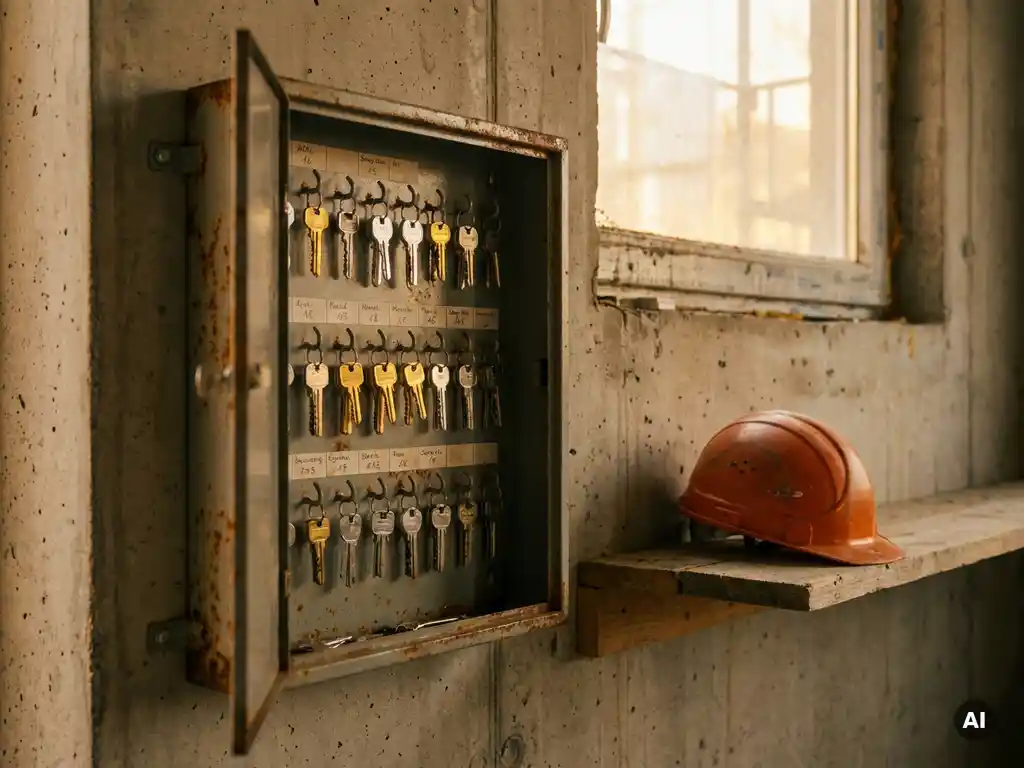
How do you prevent losing keys on the construction site?
You prevent key loss on the construction site through a combination of a strict key registration system, clear procedures for issuance and return, and, where possible, the switch to digital access solutions. Construction sites are dynamic environments with many changing employees, subcontractors, and suppliers, as a result of which access control requires extra attention. This article answers the most frequently asked questions about key management on the construction site, from causes to concrete solutions. Do you have an immediate question? Feel free to contact us with Sellox.
Why do keys get lost so often on construction sites?
Keys are lost so frequently on construction sites because many people require access simultaneously, there is hardly any central overview of who has which key, and work pressure leads to a carelessness regarding issuance and return. The combination of high staff turnover, rotating shifts, and an informal working atmosphere makes key management structurally vulnerable.
Specifically, the following factors play a major role:
- Many different users: In addition to permanent employees, subcontractors, suppliers, and inspectors also require regular access. Every handover is a moment of risk.
- Lack of registration: On many construction sites, keys are issued verbally or informally, without a written record of who received what.
- Time pressure: Construction projects operate on tight schedules. Employees have little time for administrative tasks, causing key handovers to quickly become sloppy.
- Varying locations: Keys are taken to other locations or kept at home, which increases the risk of loss or theft.
The result is that at the end of a project, it is often unclear where some of the keys have gone, and no one knows exactly who is responsible.
What are the consequences of lost keys on a construction site?
Lost keys on a construction site lead to immediate safety risks, high replacement costs, and potential delays. When it is unknown who holds a key, unauthorized access to the property, tool storage, or locked areas cannot be ruled out. In the worst case, all locks must be replaced.
The consequences can be divided into three categories:
Safety risks
A lost key means that someone outside the project organization may have access to the construction site. This increases the risk of theft of materials and tools, but also of vandalism or unsafe situations for bystanders entering the site.
Financial consequences
Replacing locks is costly, especially when it involves certified or security cylinders. Moreover, searching for a missing key takes time that comes at the expense of project progress. If a contractor is contractually responsible for the security of the property, liability issues may also arise.
Organizational disruptions
As long as it is unclear who holds a key, certain areas cannot be opened or emergency measures must be taken. This disrupts the schedule and can lead to frustration among clients and other parties on the construction site.
How do you set up a key registration system for a construction site?
You set up a key registration system for a construction site by inventorying all keys, maintaining a central register of issuance and return, and appointing one responsible person as key manager. This does not have to be complex: a well-maintained digital or paper logbook is already a big step forward.
Follow these steps for a working system:
- Inventory all keys: Assign a unique number or label to each key. Note which rooms or locks belong to that key.
- Appoint a key manager: Appoint one person responsible for issuing, receiving, and maintaining the register. This can be the site manager, the project leader, or a specific employee.
- Register every issue: Record who receives the key, on what date, for what purpose, and when the key is returned. Have the recipient sign for receipt.
- Check regularly: Perform a key check periodically, for example weekly or at the change of shift, to verify that all keys are present.
- Process returns immediately: Ensure that surrendered keys are immediately removed from the register so that the overview remains up-to-date.
For larger projects or projects with many changing users, digital key management systems are available that automate registration and provide a real-time overview.
Which rules and procedures help prevent key loss?
Clear rules and procedures help prevent key loss by assigning responsibility to individuals and eliminating arbitrariness in the handling of keys. Without written agreements, no one can be held accountable for negligent behavior.
Effective measures include:
- Include key policy in the project documentation: Describe in the safety plan or project manual how keys are issued, used, and collected.
- Do not take keys home: Establish a rule that keys are returned to the key manager at the end of the workday or stored in a locked key cabinet.
- Prohibition on passing on: An employee who has received a key may not pass it on to a colleague or subcontractor without registration.
- Deposit or signature upon issuance: Have employees sign for receipt. This increases the sense of responsibility.
- Key handover upon project change: Ensure a formal handover moment when an employee leaves the project, including checking returned keys.
Actively communicate these rules at the start of the project and reiterate them when introducing new employees or subcontractors.
What are the best alternatives to physical keys on a construction site?
The best alternatives to physical keys on a construction site are electronic access control with cards or codes, smart locks with time-based access, and key safes. These solutions make it possible to centrally manage access, restrict it to specific time windows, and register it without physical keys changing hands.
The most commonly used alternatives are:
- Electronic access cards: Employees receive a pass or tag that grants access to specific zones. Passes are easy to block in case of loss and leave a digital trail of who had access and when.
- Combination locks or code locks: Can be made temporarily accessible via a code that is changed periodically. Suitable for less sensitive access points such as storage containers.
- Key safes: Physical keys are stored in a safe that is only accessible with a code or card. This way, keys remain on-site, but access is controlled.
- Smart locks with app management: Temporary access rights can be granted and revoked via an app, without the need for a physical key. Ideal for situations with many changing users.
The choice of an alternative depends on the duration of the project, the number of users, and the level of security required by the object. Professional access management offers a customized solution that aligns with the specific situation of the construction site.
What do you do if a key gets lost on the construction site?
If a key is lost on the construction site, take immediate action: report the loss to the key manager, assess the security risk, and decide based on that assessment whether the locks need to be replaced. Acting quickly limits the damage and shows that the project organization takes the matter seriously.
Follow these steps in case of key loss:
- Report the loss immediately: The employee who has lost the key reports this immediately to the key manager. The sooner it is known, the sooner measures can be taken.
- Assess the risk: Determine which rooms or objects the lost key unlocks. Is it a key to a sensitive room or a less critical access point? That determines the urgency of the next steps.
- Inform the client: In the event of the loss of a key providing access to the property to be built or renovated, the client must generally be notified contractually.
- Replace locks if necessary: If the risk of unauthorized access is real, lock replacement is the only sure measure. Delaying this unnecessarily increases the risk.
- Document the incident: Document what happened, what measures were taken, and who was responsible for the key. Use this as input to improve procedures.
Key loss can never be completely ruled out, but a quick and structured response minimizes the consequences. Would you like to know how Sellox can help your construction site with professional access management? Contact us and discuss the possibilities.
Frequently Asked Questions
How often do I need to perform a key check on a large construction site?
On large construction sites with many rotating employees and subcontractors, a daily key check at the end of the workday is ideal, but a check of at least weekly is feasible and effective for most projects. Link the check to fixed times, such as shift changes or construction meetings, so that it becomes a natural part of the daily routine. Digital key management systems can automate this process and provide real-time alerts when a key is not returned on time.
Who is liable if a key is lost: the contractor or the employee?
Liability depends on the contractual agreements between the contractor and the client, and on the company's internal policy. In most cases, the contractor is contractually responsible for the security of the property and, consequently, for the loss of keys. Internally, the contractor can hold the employee accountable in the event of demonstrable negligence, provided this is documented in writing in the key policy or the employment contract. It is therefore advisable to always have employees sign for receipt of a key.
What is a key safe and when is its use sensible on a construction site?
A key safe is a secure storage box for physical keys, accessible via a PIN code or card, that is mounted at a fixed location on the construction site. Its use is particularly useful when employees require access at varying times and there is no permanent key manager present, such as during early or late shifts. This ensures that keys always remain on site and access is controlled without the need for a physical handover from person to person.
Can I also use a digital key management system for short-term construction projects?
Yes, digital key management systems are also suitable for short-term projects, especially when there are many changing users or a high level of security is required. Some providers offer flexible subscription models or rental arrangements tailored to the duration of a project, keeping the investment proportionate. For very short-term jobs with few users, a well-maintained digital logbook combined with a key safe may already be sufficient.
How do I involve subcontractors and suppliers in the key policy without making it too bureaucratic?
Include the key policy in the introductory briefing that every new party receives at the start of their work on the construction site, so that expectations are immediately clear. Keep the procedure as simple as possible: a brief signature upon issuance and return is sufficient in most cases. By presenting the policy as a standard safety measure, comparable to wearing personal protective equipment, it is more readily accepted as part of professional working practices.
What are common mistakes when setting up a key registration system?
A common mistake is that the register is created but not consistently maintained, causing the overview to quickly become outdated and lose its value. Another pitfall is the lack of a clear person responsible: if anyone is allowed to update the register without central control, inconsistencies arise. Finally, many project organizations forget to evaluate the system after a project is completed, causing lessons learned to be lost and the same mistakes to be repeated in the next project.
Are there legal obligations regarding key management on construction sites in the Netherlands?
There is no specific legislation that regulates key management on construction sites in detail, but the Working Conditions Act (Arbowet) does require employers to guarantee a safe working environment, which indirectly also applies to access security. Additionally, contractual obligations towards the client, insurance requirements, or certifications such as VCA may impose specific requirements on the security of the construction site. It is advisable to check the policy conditions of the business liability insurance, as careless handling of keys can affect coverage in the event of damage.