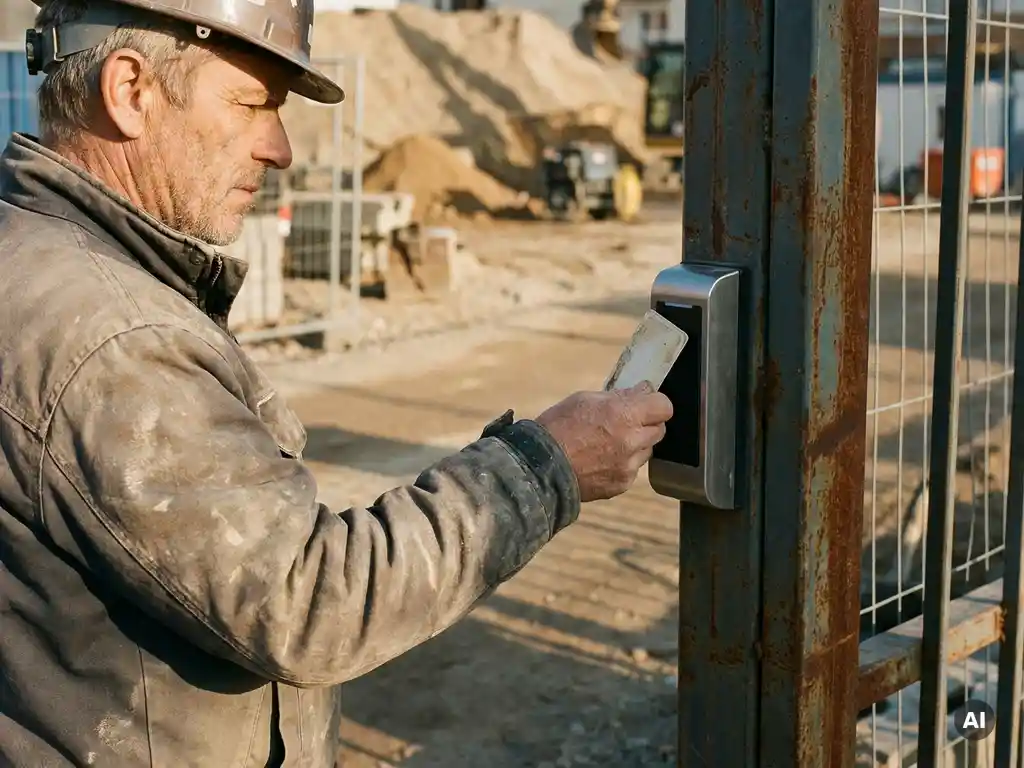
How do you grant access to rotating construction workers?
Granting access to changing construction workers is done by using a flexible access management system that can quickly register new users and easily revoke existing access rights. Think of temporary badges, programmed keys, or digital access passes that are configured per person or per period. This works best in combination with a central registration of all persons present on the construction site. In this article, we answer the most frequently asked questions about access control on construction projects. Do you have an immediate question? Feel free to contact us with our team.
What methods are available for temporary access control on a construction site?
For temporary access management on a construction site, the most commonly used methods are: temporary access passes or badges, PIN code systems, key safes with changing codes, and digital access control systems with app integration. Each method offers a different balance between ease of use and security level. The choice depends on the project duration, the number of changing personnel, and the sensitivity of the location.
For short-term projects or small construction sites, a simple system with numbered badges issued upon arrival and collected upon departure is often sufficient. However, for larger or long-term projects, a digital system is much more practical. This allows you to set, modify, and revoke access rights remotely without anyone needing to be physically present at the entrance.
Key safes with changing codes are an interim solution widely used on construction sites. The code is changed regularly and shared only with active employees. The disadvantage is that you have less control over exactly who had access and when, which quickly becomes a problem for registration and liability on larger projects.
How do you register changing construction workers quickly and safely?
You can quickly and securely register rotating construction workers by setting up a digital onboarding process at the start of the project, where each employee enters their details once and receives a personal access card or code. Link this to a central registration system so you always know who is present on the construction site.
In practice, a structured approach looks as follows:
- Collect the personal data of all expected employees in advance via the main contractor or subcontractors.
- Specify for each employee the period and zones for which access applies.
- Activate the access pass or code on the start date and set an automatic expiration date.
- Automatically register every entry and exit via the system.
- Ensure that new employees always report to the site manager or security manager before their access is activated.
By working with expiration dates per employee, you prevent former construction workers from unintentionally retaining access. This is one of the most common mistakes in temporary access management: registration at the start is well organized, but revoking access is forgotten.
What are the legal obligations regarding access on a construction site?
On a construction site in the Netherlands, you are legally required to be able to demonstrate who is present at the location at any given time. This stems from the Working Conditions Act and the obligations regarding the Sham Employment Arrangements Act. Additionally, for projects involving subcontracting, there is an obligation to provide identification for all employees.
In concrete terms, this means that as the main contractor or client, you are responsible for maintaining an attendance register. Employees must be able to identify themselves, and it must be clear for which client or subcontractor they are working. During inspections by the Inspectorate SZW, the absence of this registration can lead to fines.
Furthermore, at the European level, the GDPR applies to the personal data you collect during employee registration. You may only process data that is necessary for the purpose, you must inform employees about the processing, and the data may not be retained longer than necessary. A good access control system takes this into account by default by automatically deleting data after the completion of a project or a set retention period.
How do you revoke access for construction workers who are no longer active?
You revoke access for inactive construction workers by deactivating their access card or code in the central system. With a well-configured digital access management system, this is an action that takes only a few seconds and can be performed remotely, without the need to be physically present at the construction site.
In practice, this most often goes wrong because no clear process has been agreed upon for reporting departing employees. Therefore, ensure a fixed procedure:
- Hold the main contractor or site manager responsible for reporting departing employees.
- Use automatic expiration dates so that temporary access stops automatically after the set period.
- Check weekly or monthly which accounts are still active and compare this with the current staff list.
- Have employees physically hand in their badge or pass upon departure as an additional check.
With digital systems, you can also set access to automatically expire after a certain number of days of inactivity. This is a useful security measure for situations where someone is absent for an extended period but is formally still on the list.
Which access control system is best suited for a construction project?
The access control system best suited for a construction project is a scalable, digital system that is easy to install, operates without fixed cabling, and manages remote access. For most construction projects, a wireless system with cloud-based management is the most practical choice, as the infrastructure on the construction site changes throughout the project.
Smaller and short-term projects
For projects with a duration of a few weeks to a few months and a limited number of employees, a simple system with programmed access cards or a key safe with a changing code is often sufficient. The barrier to installation is low and the costs are limited. The disadvantage is that the registration options are less extensive.
Larger and long-running projects
For larger construction projects with dozens or hundreds of rotating employees, a fully digital system with central management software is virtually indispensable. This allows you to set access rights per employee, per zone, and per time slot, and see who is present in real time. This also supports the statutory attendance registration requirement directly from the system.
When choosing a system, also pay attention to the following points: installation time and required materials, the possibility of using the system elsewhere after the project is completed, integration with existing HR or planning software, and the availability of technical support in the event of malfunctions. A system that can be deployed on multiple projects quickly pays for itself.
Good access management on a construction site starts with choosing the right system and ends with the consistent execution of registration and deactivation. Are you unsure which system best suits your project or organization? Contact us and we are happy to think along with you.
Frequently Asked Questions
Can I also use an access control system on multiple construction projects simultaneously?
Yes, most modern digital access control systems are designed to be managed simultaneously at multiple locations from a single central environment. You can set up separate zones, users, and access rights per project without the systems interfering with each other. This makes it particularly cost-efficient: the investment in the system is spread across multiple projects, and the administrator does not need to log in separately for each location.
What do I do if a construction worker loses his access card?
In the event of a loss of an access card, you must immediately deactivate the lost card in the central system to prevent anyone else from misusing it. Subsequently, you create a new card and activate it for the same employee with the same access rights. It is advisable to have a fixed protocol for these types of situations, including a notification obligation for the employee and a log entry of the deactivation.
How do I handle access management for subcontractors who only work on the construction site for one day?
For one-day visitors or subcontractors, you can create temporary access passes with an expiry date of the same day, or use a day pass that is issued upon arrival and collected upon departure. In a digital system, you set access for a specific time window, for example from 07:00 to 18:00 on the day in question. Always ensure that these short-stay visitors are also registered in the attendance overview, as the statutory registration requirement applies to them as well.
Which data am I allowed and not allowed to record about construction workers under the GDPR?
You may only process personal data that is necessary for the purpose of access management and attendance registration, such as name, employer, access period, and entry and exit times. Special categories of personal data, such as health data or biometric data, require an explicit legal basis and are in most cases not permitted without explicit consent. Inform employees in writing in advance about which data you collect, how long you retain it, and with whom you share it.
Is a wireless access control system reliable enough for use on a construction site?
Modern wireless systems are specifically designed for use in harsh environments and are resistant to dust, moisture, and fluctuating temperatures. They use encrypted connections and often feature an offline mode to ensure access is guaranteed even during a temporary internet outage. When purchasing, pay attention to the IP protection class of the hardware and preferably choose equipment certified for outdoor use.
How do I prevent employees from passing their access cards on to colleagues?
You can prevent the transfer of access passes by using personal verification, such as a combination of a pass and a PIN code, or by using a photo identification system where a security guard or camera at the entrance verifies the passport photo. Digital systems with two-factor authentication make it technically virtually impossible to transfer a pass. Additionally, make employees aware of the rules and document the consequences of sharing access credentials in the access policy.
What are the average costs of a digital access control system for a construction project?
The cost of a digital access management system for a construction project varies significantly depending on the project size, the number of access points, and the desired functionalities. For smaller projects, entry-level solutions are available starting from a few hundred euros, while comprehensive systems for large projects can run into several thousand euros for hardware and installation. Also, take into account any subscription costs for the management software and the option to redeploy the system after the project is completed to spread the total investment.