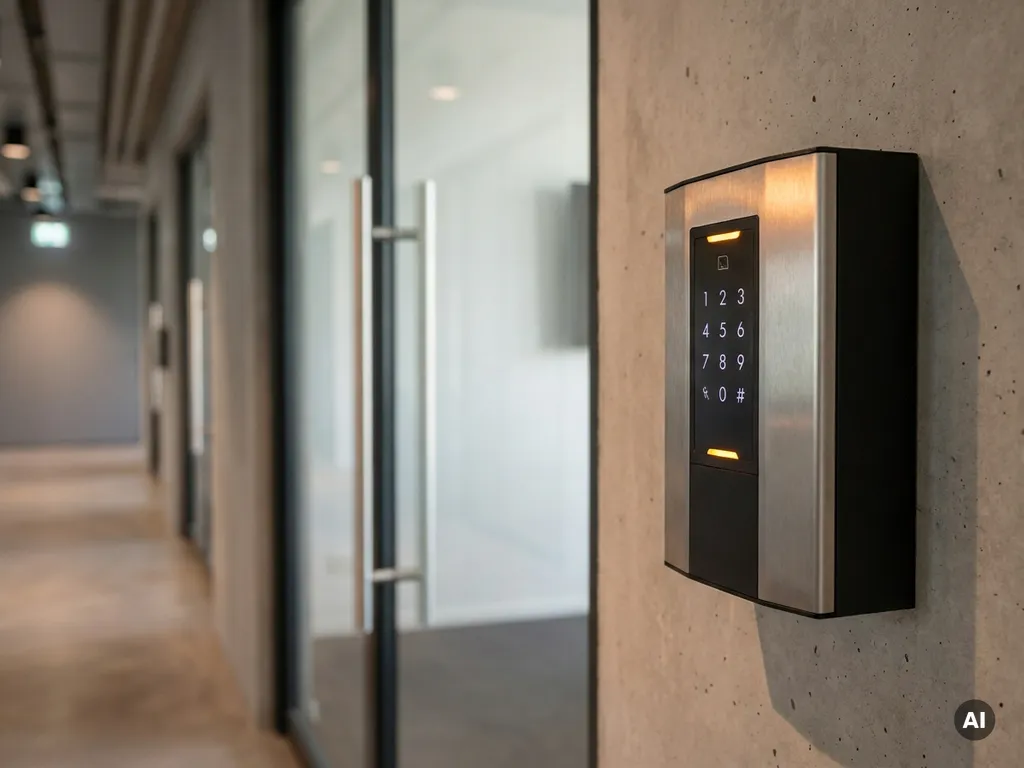
What does an access control system cost on average?
An access control system costs on average between €500 and €5,000 for a small-scale installation, while larger or more complex systems can quickly rise to €10,000 or more. The final price depends heavily on the type of system, the number of doors or access points, and whether you choose a cloud solution or an on-premises system. If you are curious about what a system would cost for your situation, you can always contact for a no-obligation consultation. In this article, we answer the most frequently asked questions about the costs of access management, from procurement to installation and recurring expenses.
Which factors determine the price of an access control system?
The price of an access control system is determined by the number of access points, the chosen technology type, the desired functionalities, and the complexity of the installation. Each of these factors can significantly influence the total price, either upwards or downwards.
The number of doors or gates you wish to secure is the most direct cost driver. Every additional access reader, controller, or locking mechanism adds hardware and installation costs. Additionally, the choice of technologies plays a major role: a simple PIN code system is cheaper than a system based on biometrics or smart cards with multiple authentication factors.
Furthermore, integrations with other systems, such as a burglar alarm, time recording, or camera surveillance, determine the complexity and, consequently, the price. A system fully custom-configured for a large commercial building requires more customization than a standard package for a small office space.
What are the average costs per type of access control system?
The average costs per type of access control system vary widely. A simple standalone system with a PIN code or card starts at around €200 to €500 per door. Networked systems with central software typically cost €500 to €1,500 per access point, while biometric or fully integrated systems can run up to €2,000 or more per location.
Standalone systems
Standalone systems operate without a network connection and are ideal for small locations with one or a few doors. They are relatively inexpensive to purchase but offer limited management capabilities. Changes to access rights often have to be implemented manually per device.
Network-bound and cloud-based systems
Network-based systems can be centrally managed via software and offer greater control over who has access and when. The higher purchase price is compensated by more efficient management, especially with multiple locations or larger numbers of users. With a cloud-based access management Moreover, you do not pay large upfront investment costs, but a monthly subscription.
What are the recurring costs after the purchase?
After purchasing an access control system, you take into account recurring costs for maintenance, software updates, licenses, and any support contracts. With cloud solutions, monthly subscription costs are added to this, ranging from €5 to €30 per door per month, depending on the provider and the package.
Maintenance includes periodic checks of hardware such as readers, locks, and controllers. Defective parts must be replaced, and additional licenses or hardware may be required if the premises or workforce expands. Some suppliers offer an all-in service contract in which all these costs are bundled, making budgeting easier.
For local systems, you are responsible for updates and backups of the management software. This requires internal IT capacity or a separate maintenance contract, which is also a cost that you must factor in beforehand.
When is a cloud-based system cheaper than an on-premises system?
A cloud-based system is generally cheaper than an on-premises system when you have limited in-house IT infrastructure, want to manage multiple locations, or want to scale up quickly without large upfront investments. With a small number of access points and a limited budget, an on-premises system may initially seem cheaper, but in the long run, management and maintenance costs become more significant.
The comparison depends heavily on the time horizon. An on-premises system has higher one-off costs but lower monthly expenses. A cloud solution spreads costs over time and makes updates and expansions easier. For organizations that value flexibility and scalability more than a low monthly bill, the cloud is almost always the better choice in the long run.
Companies with strict requirements for data storage or security sometimes deliberately choose an on-premises system, even if it is more expensive. In that case, compliance considerations outweigh the pure cost calculation.
How much does the installation of an access control system cost?
The installation costs of an access control system average between €150 and €500 per access point, excluding the hardware itself. For a complete project involving multiple doors, cabling, and commissioning, the total installation price can quickly rise to several thousand euros.
The installation price is influenced by the structural situation of the building. In an existing building, cabling often has to be routed through walls or ceilings, which requires more labor than in a new build situation. Wireless systems can reduce installation costs, but they entail different requirements regarding power supply and signal strength.
In addition to the physical installation, this also includes configuring the software, creating users, and testing the system. A professional installer includes these steps in the quotation so that the system is fully functional immediately after delivery.
How do you compare quotes for an access control system?
To properly compare quotes for an access control system, look at the total cost of ownership over several years, not just the purchase price. Include hardware, installation, licenses, maintenance, and any subscription fees in the calculation to compare like with like.
Ask each provider for a detailed quotation with the following items:
- Costs per access point (hardware and installation separate)
- One-time software licenses or monthly subscription fees
- Annual maintenance and support costs
- Costs for expansion due to additional doors or users
- Warranty conditions and response times for malfunctions
Also pay attention to what is not included in the quote. Are cabling and structural modifications included? Is commissioning and staff training included? Small differences in the quote can mean significant cost differences once the project actually starts. By comparing quotes on these points, you make an informed choice that fits your budget and needs. Would you like help comparing, or would you like to receive a quote immediately? Contact us and we are happy to think along with you.
Frequently Asked Questions
What is a realistic budget for a small business with two or three doors?
For a small business with two to three access points, you can expect a total budget of roughly €1,500 to €4,000, including hardware, installation, and initial commissioning. A standalone or simple network-attached system is sufficient for this scale in most cases. Additionally, take into account annual maintenance or subscription costs of several hundred euros, depending on the chosen solution.
Can I expand an access control system later if my company grows?
Yes, most modern networked and cloud-based systems have a modular structure, making them easy to expand with additional access points, users, or locations. However, it is important to inquire about scalability and the cost per extra door or license at the time of purchase to avoid surprises. Preferably, choose a platform that scales with your organization so that you do not have to replace the entire system after a few years.
Are there any hidden costs I need to take into account?
Common hidden costs include structural modifications such as concealing cabling, additional licenses due to workforce growth, and costs for training employees or administrators. The replacement of outdated hardware after a few years and costs for integrations with existing systems such as camera surveillance or time tracking are also frequently underestimated. Always explicitly ask your supplier about these items before signing a quotation.
What is the difference between a maintenance contract and a service contract, and do I need one?
A maintenance contract typically covers preventive inspections and the replacement of wear parts, while a service contract also includes reactive support in the event of failures, including agreed response times. For business-critical environments where uninterrupted access is essential, a service contract is highly recommended. For smaller installations, a single annual maintenance agreement may suffice, provided you have someone internally who can resolve minor issues.
How long does an access control system last on average before replacement is needed?
High-quality hardware such as readers, controllers, and electronic locks lasts an average of 8 to 15 years, provided it is properly maintained. Software and cloud platforms are typically continuously updated, meaning the digital side of the system lasts longer than the physical components. In most cases, the practical lifespan is determined more by changing security requirements or technological obsolescence than by mechanical wear.
Is it cheaper to install an access control system yourself?
Self-installation is technically possible for simple standalone systems, but for networked or cloud-based solutions, professional installation is strongly recommended. Errors in cabling, configuration, or integration can lead to security vulnerabilities or malfunctions that are expensive to repair later. The savings on installation costs rarely outweigh the risks and time required for a do-it-yourself approach, especially if you have no technical background.
Are there subsidies or tax benefits available for the purchase of an access control system?
In some cases, as an entrepreneur, you can make use of the Small-Scale Investment Deduction (KIA) or the MIA/Vamil scheme if the system contributes to sustainability or innovation. Additionally, the purchase and installation costs of business assets are in most cases deductible as business expenses. Consult your accountant or tax advisor to determine which schemes apply to your situation and how much benefit you can obtain.