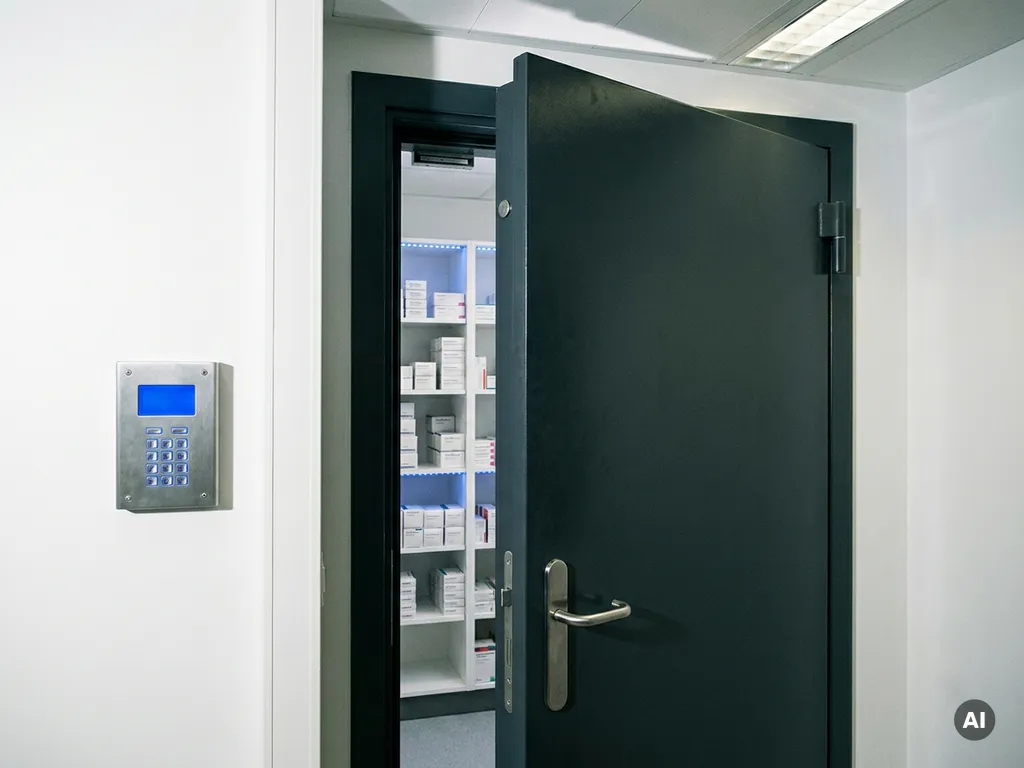
How do you secure a pharmaceutical warehouse?
You secure a pharmaceutical warehouse with a combination of access control, camera surveillance, strict procedures, and optionally professional security. Due to the high value of medicines, strict regulations, and the risk of theft or misuse, pharmaceutical storage requires a layered security approach that goes beyond standard warehouse security. In this article, we answer the most frequently asked questions about securing a pharmaceutical depot. Would you like immediate, tailored advice? Feel free to contact us with Sellox.
What risks are specific to pharmaceutical warehouses?
Pharmaceutical warehouses face specific risks associated with the nature of the stored products. Medicines, vaccines, and raw materials have a high monetary and societal value, making them attractive targets for theft. In addition, risks such as unauthorized access, sabotage, product manipulation, and violations of temperature-sensitive storage requirements play a major role.
Some risks that distinguish pharmaceutical warehouses from ordinary storage locations:
- Theft of high-value medicines, including opioids, antivirals and vaccines
- Internal fraud by employees with access to valuable stocks
- Product manipulation or falsification, whereby products are swapped or affected
- Non-compliance with storage conditions by unauthorized persons gaining access to controlled zones
- Data leaks via systems that manage inventory information
Because the consequences of a security incident in a pharmaceutical warehouse extend beyond financial damage—namely to public health risks as well—a proactive and layered security strategy is indispensable.
Which access control systems are suitable for a pharmaceutical warehouse?
For a pharmaceutical warehouse, access control systems based on zone-based identification and authorization are suitable. Examples include badge or card readers, biometric systems such as fingerprint or iris scanners, and key card systems linked to a central management system. These systems make it possible to determine, on a per-employee basis, which areas are permitted access to.
A good access control system for pharmaceutical storage meets a number of specific requirements:
- Zoning: distinction between general workspaces, cold storage, vault rooms and administrative zones
- Audit trail: registration of who had access to which room and when
- Time-limited access: access rights that are automatically restricted to working hours or specific services
- Integration with alarm systems: automatic notification for unauthorized access attempts
Biometric systems offer extra security because they are non-transferable, unlike passes or badges that can be stolen or shared. For areas containing narcotics or controlled substances, a higher security class is typically required by law.
How does camera surveillance work in a pharmaceutical depot?
Camera surveillance in a pharmaceutical depot serves as both a deterrent and a means of recording. Cameras are strategically placed at entrances, exits, loading docks, vault areas, and work corridors to capture all movements of people and goods. Recordings are retained for a specific period so that incidents can be investigated retrospectively.
An effective camera system for a pharmaceutical warehouse combines multiple functions:
- Continuous recording of all access points and storage zones
- Motion detection with direct notification of activity outside working hours
- High resolution for facial recognition and reading product labels or barcodes
- Integration with the access control system so that access events are automatically linked to camera footage
In some cases, camera surveillance is supplemented with live monitoring by a control room, allowing operators to intervene immediately in suspicious situations. This is particularly relevant for depots that operate outside regular working hours or manage large inventories.
What are the legal security requirements for pharmaceutical storage?
The legal security requirements for pharmaceutical storage are laid down in European and national regulations, including the European Union's Good Distribution Practice (GDP) guidelines. These guidelines set requirements for the physical security of storage locations, access control, registration of access, and the protection of medicines against theft and counterfeiting.
In concrete terms, for a pharmaceutical warehouse in the Netherlands, this means:
- Mandatory access restriction to authorized personnel
- Registration and storage of access credentials
- Separate and secure storage of narcotic drugs and psychotropic substances in accordance with the Opium Act
- Periodic risk analyses and internal audits
- Documentation of security measures as part of the quality management system
Companies operating with a wholesale license for medicinal products (WDA license) are inspected by the Health and Youth Care Inspectorate (IGJ). Insufficient security can lead to the revocation of the license. It is therefore advisable to have the security setup reviewed by a specialist with knowledge of GDP requirements.
How do you prevent theft of medicines in the warehouse?
Theft of medicines in the warehouse is prevented by a combination of technical measures, procedural controls, and employee awareness. No single measure is sufficient on its own; effective prevention requires a layered approach in which access, control, and registration are coordinated.
Technical measures
Technical measures form the first line of defense. Examples include access control systems that track individual access rights, camera surveillance that records all movements, and electronic article security for high-value products. Vaults or locked cabinets for controlled substances are also essential.
Procedural checks
In addition to technology, procedures are indispensable. Four-eyes principles when handling valuable shipments, periodic inventory checks, and strict separation of duties reduce the risk of internal abuse. Maintaining a detailed logbook of all incoming and outgoing goods makes discrepancies quickly visible.
Which security service is suitable for a pharmaceutical warehouse?
A security service suitable for a pharmaceutical warehouse possesses knowledge of the specific laws and regulations for drug storage, experience with high-value and sensitive environments, and the capacity to integrate both physical surveillance and technical security systems. Generalist security services without sector-specific knowledge are insufficient in most cases.
When choosing a security service for a pharmaceutical depot, pay attention to the following criteria:
- Knowledge of GDP and IGJ requirements
- Experience with access control and camera surveillance in regulated environments
- Availability of mobile surveillance or a 24/7 control room
- Possibility of customization based on a risk analysis of your specific location
- Certification and permits in accordance with the Private Security Organizations and Detective Agencies Act (Wpbr)
Sellox offers security solutions specifically tailored to the requirements of your pharmaceutical warehouse, from access control to CCTV surveillance and professional security. Would you like to know which approach best suits your situation? Contact us and we are happy to think along with you.
Frequently Asked Questions
How do I start setting up a security plan for a pharmaceutical warehouse?
Start with a thorough risk analysis of your specific location, considering the nature of the stored products, the layout of the premises, the number of employees, and operating hours. Based on this, develop a layered security plan that combines access control, camera surveillance, procedures, and potentially physical security. It is highly recommended to engage a specialist familiar with GDP guidelines and IGJ requirements to ensure your security plan immediately complies with legal requirements.
What should I do if a security incident has occurred in my pharmaceutical depot?
Immediately follow your incident response protocol: secure the location, notify involved parties (including supervisors and, if applicable, the police), and retain all available evidence such as camera footage and access logs. In the event of theft or tampering with medicines, you are in many cases required to report this to the IGJ. Fully document the incident as part of your quality management system and conduct a thorough analysis afterwards to prevent recurrence.
How long must camera footage and access logs be retained in a pharmaceutical warehouse?
GDP guidelines stipulate that access records must be retained for at least five years as part of traceability documentation. In the Netherlands, there is no legally established minimum retention period for camera footage, but a retention period of four weeks is common and sufficient for most incident investigations. Always check whether your specific permit conditions or internal quality guidelines impose different requirements regarding retention periods.
What is the difference between standard warehouse security and security specifically designed for pharmaceutical storage?
Standard warehouse security focuses primarily on preventing break-ins and theft from the outside, whereas pharmaceutical warehouse security also addresses internal threats, product manipulation, and compliance with strict regulations. Pharmaceutical security requires detailed audit trails, zoning based on product category (such as separate storage for controlled substances), and integration with quality management systems. Furthermore, security measures must be demonstrably documented for regulators such as the IGJ.
As a small pharmaceutical company, can I also meet all security requirements without incurring enormous costs?
Yes, even smaller pharmaceutical companies can cost-effectively meet statutory security requirements by prioritizing smartly based on a risk analysis. Invest first in mandatory basic measures such as access control with an audit trail and camera surveillance at critical points, and expand this incrementally as the company grows. Modular security systems and outsourcing monitoring to a control room are often more cost-effective alternatives for smaller locations than deploying full-time security personnel.
How do I handle temporary employees or external suppliers who need access to the warehouse?
Establish a strict policy for temporary access, whereby visitors, temporary workers, and external suppliers are always accompanied by an authorized employee and are never permitted to remain in secured zones unsupervised. Use time-based access rights in your access management system that automatically expire after the scheduled work period, and always record the identity and purpose of each visit. Also ensure that external parties sign a confidentiality agreement and are aware of the applicable safety and conduct rules within the depot.
What common mistakes should I avoid when securing a pharmaceutical warehouse?
A common mistake is relying on only a single security measure, such as exclusively camera surveillance, without supplementing it with access control and procedural checks. Other common errors include failing to regularly update access rights when personnel changes occur, lacking a documented incident response plan, and not conducting periodic internal audits. Finally, ensure that security is not a static entity: conduct a risk analysis at least annually and adapt your security plan to new threats or changes in regulations.